 Luxury Egypt
Is It Safe to Travel to Egypt? What the Advisories Actually Say
Is it safe to travel to Egypt? About one million British people visit each year and the honest answer is that the risk depends on where you go and how you get around. The UK Foreign Office advises against travel to North Sinai and the Libyan border area, yet the same advice treats Luxor, Aswan and Abu Simbel as normal tourist destinations. This page goes through the advisories, then through the risks you will actually meet: touts at the pyramids, taxi scams, road accidents, heat and health. It also explains how a private tour with a licensed Egyptologist, such as the 8-Day Cairo Aswan Luxor Private Tour at $1,800 per person, changes the picture. The bookable tours are compared on luxury Egypt tour packages.
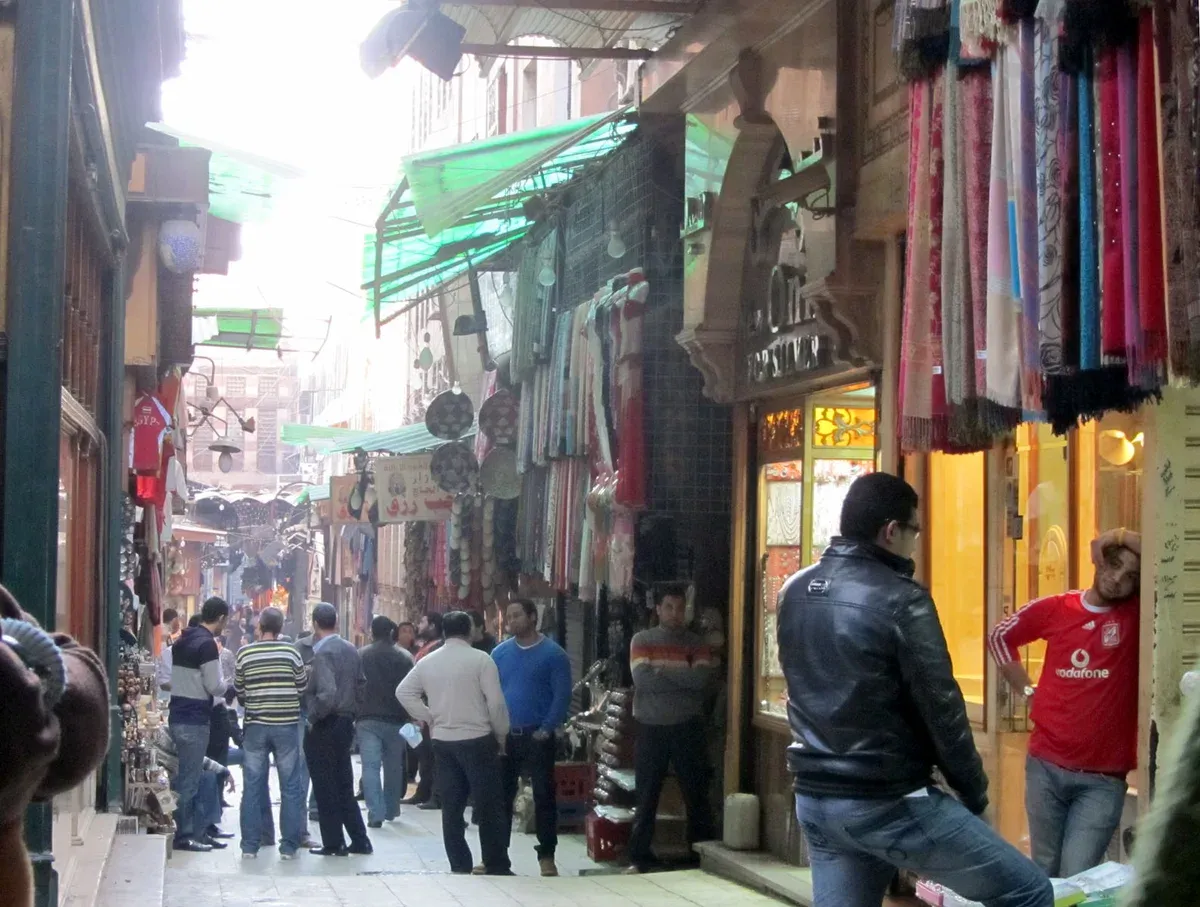
Shoppers and stallholders in a narrow lane of the Khan el-Khalili bazaar. Photo: RThiele, CC BY-SA 3.0, via Wikimedia Commons
Quick answer The short answer
Yes, for the classic tourist route, with about one million British people visiting Egypt each year according to the UK FCDO. The FCDO advises against all travel to North Sinai and travel within 20 km of the Libyan border, but treats Cairo, Luxor, Aswan and Abu Simbel as ordinary destinations. The main risks are road accidents, scams and touts, heat, and harassment of women.
Key takeaways
- Read the advisory wording in detail in the advisories section, with the exact areas singled out by the UK, Canada and Australia.
- Scams at the pyramids, taxi pressure and road safety are the everyday risks, covered one by one in the risks section.
- A private guide removes most scam exposure. The 7-Day Private Egyptologist Tour at $1,500 per person includes a licensed Egyptologist, though its hotel and flights cost extra.
- The route itself is on the homepage under the classic route stop by stop, and timing matters for heat, so check the best time to visit Egypt.
What the Travel Advisories Say
Three governments publish detailed wording on Egypt. Here is what each one actually says, and what it means for the route most visitors take.
The Wording, Government by Government
The table below compares the official wording and the areas each government singles out. The UK FCDO is the most detailed of the three. Canada advises a high degree of caution overall. Australia's Smartraveller advice could not be confirmed from an official page, so no level is printed here. The US State Department level also could not be confirmed, so this page does not state one.
The key detail is what the advisories do NOT say. None of them advises against Cairo, Luxor, Aswan, Abu Simbel, a Nile cruise between Luxor and Aswan, or the Red Sea resorts. The FCDO's Western Desert advice explicitly excepts tourist destinations such as Luxor, Aswan and Abu Simbel. That distinction is the whole answer to is Egypt safe for tourists: the map of concern is specific, and it does not cover the classic route.
| Government | Wording | Areas singled out |
|---|---|---|
| UK FCDO | Terrorists are likely to try to carry out attacks in Egypt, which may target foreign nationals at tourist sites, religious locations and public gatherings | Against all travel to North Sinai, against all travel within 20 km of the Libyan border except El Salloum town, against all but essential travel to Ismailiyah east of the Suez Canal, northern South Sinai beyond the St Catherine to Nuweiba road, the Hala'ib Triangle, Bir Tawil, and most of the Western Desert, excepting Luxor, Aswan, Abu Simbel and specific oasis towns |
| Canada | Exercise a high degree of caution in Egypt, with regional advisories | Avoid all travel within 50 km of the Libyan border and west of the Giza-Luxor-Aswan road |
| Australia | Could not be confirmed from an official source, so no level is stated here | Not stated |
| United States | Could not be confirmed from an official source, so no level is stated here | Not stated |
What This Means for the Classic Route
Take the standard circuit: Cairo and Giza, then a flight or train south, then a Nile cruise between Luxor and Aswan, often with Abu Simbel. None of it falls inside an FCDO do-not-travel zone. Luxor sits about 637.2 km from Cairo by road, and most travellers fly instead, at 3h13m door to door from Cairo to Luxor according to Rome2Rio. Canada's warning about land west of the Giza-Luxor-Aswan road affects desert excursions, not the cruise itself.
Two practical points follow. First, insurance: the FCDO says travel insurance may be invalid if you travel against its advice, so stay out of North Sinai and the border strip and your policy holds. Second, dates: Canada says the terror risk rises around 25 January, Orthodox Easter, 30 June to 3 July and 14 August, which is worth knowing when you book. For season and crowd planning around those dates, see the guide to the best time to visit Egypt. If you want the whole route handled by one operator, a full 12-day itinerary such as the 12-Day Luxury Egypt Nile Tour at $6,527 per person includes domestic flights, a licensed Egyptologist at all sightseeing, and Abu Simbel, which removes the independent-planning risks covered below.
Sources: UK FCDO Egypt advice, Canada travel advice
The Real Risks, One by One
For most visitors the dangers that materialise are small and avoidable: touts, taxi pressure, road accidents, heat and illness. Here they are in order of likelihood.
Scams and Touts
Wikivoyage documents the patterns by city. At Giza, touts work the plateau and one suggested tactic is to wear headphones and repeat "La Shukran". The same source warns that Giza tourist police sometimes expect tips and that scammers can operate in front of them. In Cairo, papyrus shops call themselves galleries or museums and inflate prices, and taxi drivers may pressure visitors into expensive tours. In Luxor, touts claim a temple is closed to redirect visitors, and scarf sellers use the cloth to hide pickpocketing hand movements. In the Aswan souq, pickpockets carry scarves or papyrus as cover.
Canada adds that pickpocketing and bag snatching occur most often in tourist locations and on the metro. None of this is violence. It is pressure sales and petty theft, and it collapses when you arrive with a guide. On a private tour a guide stays with you, and entrance fees are already covered where the listing includes them. The 3-Day Private Cairo Pyramids Tour at $441 per person covers the Pyramids, Saqqara, Memphis, Dahshur and Old Cairo with three lunches and entrance fees included, which is the pyramids problem solved at its cheapest.
Roads and Transport
This is the risk the advisories rank highest. The FCDO says road accidents are frequent and that bus and train crashes have killed tourists, and advises avoiding driving outside cities and resorts at night. Canada goes further, saying Egypt's road accident rate is one of the highest in the world and advising against microbuses. The distances are long: Cairo to Luxor is 637.2 km by road, Cairo to Aswan is 848.4 km, and even Luxor to Hurghada is about 282 km and around 4 hours.
The safe choices are the ones the guides already use. Domestic flights cut Cairo to Luxor to 3h13m door to door and Cairo to Aswan to 3h48m. The overnight sleeper train from Giza departs at 20:00 and 20:30 and has one-berth or two-berth compartments and dinner on board. Sources disagree on the journey time, from about 9 hours to Luxor and 12 to Aswan up to 10h45m and 14h15m. The Luxor to Aswan drive is about 3h05m on a well-used highway. Tours handle all of this for you: the 8-Day Private Egypt Nile Cruise Tour at $3,250 per person includes flights Cairo to Aswan and Luxor to Cairo, so you never board a microbus.
Heat, Health and Harassment
Heat is a genuine risk, not a footnote. Luxor's average monthly highs reach 41.3 C in June and 41.5 C in July, and Aswan reaches 41.9 C. Cairo is milder, peaking at 35.1 C in July, and a khamsin sandstorm between March and May can raise temperatures by up to 20 C in two hours with winds up to 140 km/h. Sightseeing hours shrink in summer for good reason.
On health, the CDC recommends hepatitis A vaccine for unvaccinated travellers aged one year or older, typhoid vaccine for most travellers, and considering rabies pre-exposure vaccination because rabid dogs are common. It advises avoiding untreated water and freshwater swimming because of schistosomiasis, and repellent with 20 percent or more DEET. The FCDO says to check vaccine recommendations at least 8 weeks before travel, that some UK medicines are controlled in Egypt so carry a GP letter, and that hotel doctors have reportedly overcharged while pharmacies outside hotels are cheaper. Keep the emergency numbers: the FCDO gives 123 for an ambulance and 126 for tourist police, and Wikivoyage adds 122 for police and 180 for fire.
For women, Canada says unwanted male attention and verbal harassment are frequent, and the FCDO advises avoiding taxis alone at night and reporting sexual assaults, which have been reported mainly in Red Sea resorts. Canada says medical facilities are below Canadian standards, one reason to carry insurance that covers evacuation. Timing helps with all of this: the October to March window keeps Luxor below its 40 C months, which the seasons page covers in one line. And the 10-Day Ultimate Egypt Nile Cruise at $4,700 per person, plus a $25 charge added at checkout, includes a qualified Egyptologist and all domestic flights, so a woman travelling in a private group spends her days with one known guide rather than negotiating strangers.
Sources: UK FCDO safety and health, CDC Egypt, Wikivoyage
Is It Safe to Travel to Egypt?
A traveller's answer on how safe Egypt is for tourists and what to watch for. Third-party video by Mahna Ghafori. This site did not shoot it and has no relationship with the creator.
Laws That Catch Visitors Out
Egypt's legal rules for visitors are strict in places where other countries are relaxed. The UK FCDO lists the specifics, and the penalties are real.
Drones Are Illegal Without Permission
Flying a drone in Egypt without Ministry of Defence permission is illegal. The FCDO says the penalty can be up to 7 years in prison or fines of EGP 5,000 to 50,000. Leave the drone at home.
There is no quick tourist permit route described in the advisory, so for almost every visitor the answer is simple: do not bring one.
Photography Rules
Three photography rules matter. First, photographing military property is illegal, and the FCDO names the Suez Canal explicitly. Second, professional photography equipment needs permits, so a big rig is not just heavy, it is a legal question. Third, photographing children is banned.
Inside the monuments, sites set their own rules. At the Valley of the Kings, one visitor guide prices a camera photography pass at EGP 300 for three tombs, and DSLRs are forbidden in the Tutankhamun and Seti I tombs. Phone photos with a pass are the safe default.
Dress and Mosque Etiquette
Dress rules are about respect rather than law, but mosques enforce them at the door. Visitors should cover shoulders and legs, and women may be asked to cover their hair, so carry a scarf. Shoes come off in prayer areas. For ordinary street sightseeing, hair covering is not required.
Wikivoyage gives the same advice: modest clothing, shoes off in mosques and hair covered for women inside them. Loose, light clothing also helps with the heat, which is its own safety topic in a country where Luxor's average high passes 40 C in summer and Cairo gets only about 55 mm of rain a year.
Medicines and Money Rules
Two customs rules surprise travellers. Some UK medicines are controlled in Egypt, and the FCDO says travellers should carry a GP letter for them. Check your own prescriptions against this before you fly.
On money, no more than EGP 5,000 may be taken in or out of the country, and foreign currency above US$10,000 must be declared on arrival. Both limits come from the FCDO, and both are the kind of thing nobody reads until a customs officer asks. The visa and money basics, from the on-arrival visa to tipping customs, are gathered on the practical section of the homepage.
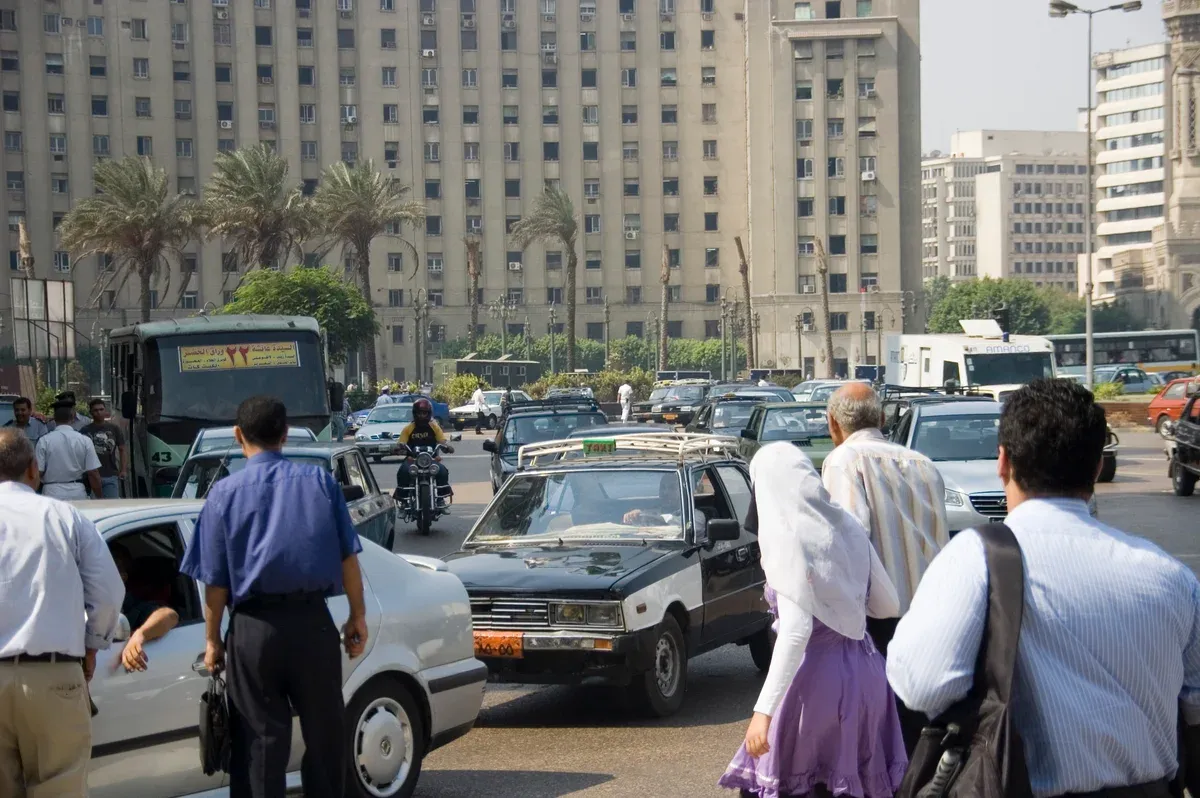
Taxis, buses and pedestrians share a busy street near Tahrir Square in Cairo. Photo: David Evers from Amsterdam, Netherlands, CC BY 2.0, via Wikimedia Commons
Is a Private Egypt Tour Safer
A private tour does not remove the risks in the advisories. It does remove several of the situations where visitors most often get into trouble.
What a Private Egyptologist and Driver Change
The commonest trouble for visitors is not crime, it is the scams at the sights. Wikivoyage warns that Giza touts work the plateau, that Cairo taxi drivers may pressure visitors into expensive tours, that Luxor touts claim a temple is closed to redirect visitors, and that scarf sellers in Luxor use the cloth to hide pickpocketing hand movements. In the Aswan souq, pickpockets carry scarves or papyrus as cover.
With a private licensed Egyptologist you walk past most of this. Someone who knows the sites is with you on the sightseeing days, the driver handles the roads, and you are not negotiating with taxis. The FCDO says Egypt's road accident rate is a serious concern and advises avoiding driving outside cities and resorts at night. A tour with its own driver puts that risk with a professional instead of with you, and it removes the taxi-at-night scenario the FCDO specifically warns women about.
Compare the private baseline, the 8-Day Cairo Aswan Luxor Private Tour at $1,800 per person with a 4.9 rating from 285 reviews, with the fully guide-led 7-Day Private Egyptologist Tour at $1,500 per person, where the Cairo hotel and both domestic flights cost extra.
Private Versus Shared Groups
Small-group tours are still escorted, but you share the guide with a group of up to 18 travellers. The 9-Day Egypt Sleeper Train Tour takes up to 18 travellers at $3,200 per person, with 113 reviews at 5 stars. The 4-Day Nile Cruise with Abu Simbel takes up to 18 on a 5-star ship from $690 per person, with 132 reviews at 4.6.
On a private tour the group size is your own party. You set the pace, the guide answers to you, and there is no waiting for a bus of strangers at each site. That is the main safety benefit: less time standing around at entrances where touts gather, and a guide who notices if one traveller has a problem.
Emergency Numbers to Save
Save these before you land. The FCDO gives 126 as the tourist police number and 123 as the ambulance number. Wikivoyage lists police at 122, ambulance at 123 and fire at 180, so different sources give different police numbers, which is worth knowing in itself.
The British Embassy in Cairo is on +20 (0)2 2791 6000 if you are a UK national. The FCDO also says to report any crime before leaving Egypt, because later prosecution is difficult. Roughly one million British people visit Egypt each year, so the systems for handling visitor problems exist, but they only work if you report while still in the country. Full advisories, health notes and insurance warnings are in the first half of this guide on whether it is safe to travel to Egypt.
Do's and Don'ts
Do
- Do buy travel insurance and check it covers your actual itinerary, because the FCDO says insurance may be invalid if you travel against FCDO advice, including into the areas advised against.
- Do carry a GP letter for prescription medicines, because the FCDO says some UK medicines are controlled in Egypt.
- Do check vaccine recommendations at least 8 weeks before travel, as the FCDO advises, and follow the CDC guidance on hepatitis A, typhoid and repellent with 20 percent or more DEET.
- Do use a tour with its own driver and licensed guide, because the FCDO says road accidents are frequent and advises avoiding driving outside cities and resorts at night.
- Do report any crime to the tourist police on 126 before you leave Egypt, because the FCDO says later prosecution is difficult.
Don't
- Don't bring a drone, because flying one without Ministry of Defence permission is illegal, with up to 7 years in prison or fines of EGP 5,000 to 50,000.
- Don't photograph military sites including the Suez Canal, children, or use professional camera gear without a permit, because the FCDO says all are illegal or restricted.
- Don't take a taxi alone at night if you are a woman, because the FCDO advises against it, and Canada says women are frequently subject to unwanted male attention and verbal harassment.
- Don't rely on hotel doctors for minor problems, because the FCDO says they have reportedly overcharged and pharmacies outside hotels are cheaper.
Safety FAQ
Is it safe for Americans to travel to Egypt?
The US State Department advisory level could not be confirmed from an official source, so no level is stated here. What is documented: the UK FCDO advises against all travel only in North Sinai, within 20 km of the Libyan border except El Salloum town, and parts of the Western Desert, with Luxor, Aswan and Abu Simbel excepted. About one million British nationals visit each year. A private option such as the 8-Day Cairo Aswan Luxor Private Tour at $1,800 per person covers the classic route with a guide and driver.
Is it safe to visit the pyramids?
The pyramids sit inside the FCDO's area without an advisory, so they are in the travel-safe zone. The real risk there is commercial: Wikivoyage warns that Giza touts work the plateau, that scammers can operate in front of tourist police, and that tourist police sometimes expect tips. Wearing headphones and saying La Shukran is the local advice. A private guided option such as the 3-Day Private Cairo Pyramids Tour from $441 per person keeps a guide with you on the plateau.
Are Nile cruises between Luxor and Aswan in a safe area?
Yes. The FCDO specifically excepts Luxor, Aswan and Abu Simbel from its Western Desert warning, and the cruise route between the two cities runs through the same corridor. Canada's 50 km Libyan border exclusion applies far west of the Giza-Luxor-Aswan road. Cruise itineraries such as the 5-Day Ultra Deluxe Nile Cruise from $2,500 per person stay inside the excepted zone.
Is Egypt safe for a woman travelling alone?
Canada says women are frequently subject to unwanted male attention and verbal harassment, and the FCDO advises women to avoid taking taxis alone at night. Sexual assaults have been reported, mainly in Red Sea resorts. A private tour addresses the transport part directly, because a driver and guide stay with you rather than you hailing taxis. Private group options start with the 7-Day Private Egyptologist Tour from $1,500 per person, hotel and flights excluded.
Is driving in Egypt safe for visitors?
Canada says Egypt's road accident rate is one of the highest in the world and advises avoiding microbuses, and the FCDO says road accidents are frequent with bus and train crashes having killed tourists. It advises avoiding driving outside cities and resorts at night. For most visitors the answer is not to drive at all: use tours with professional drivers, domestic flights such as the included Cairo to Aswan and Luxor to Cairo legs, or the sleeper train, which departs Giza at 20:00 and 20:30.
When is the safest and most comfortable time to visit Egypt?
Heat is a genuine safety factor, with Aswan average highs reaching 41.9 C in summer, and khamsin sandstorms can raise temperatures by up to 20 C in two hours between March and May. October to March suits most travellers, and Canada notes the terror risk rises around specific anniversaries including 25 January and 30 June to 3 July. The full seasonal picture is in the guide to the best time to visit Egypt.